Recommendations by publisher profile: your Discover action plan
Last part of our Google Discover Pipelines series.


Over the past weeks we’ve mapped the 20 pipelines, their selection logic, their anti-patterns, and their timing. Now the payoff: which pipelines should YOUR content target, based on what you publish?
We’ve identified 7 publisher profiles. Find yours.
The framework
For each profile:
Natural pipelines: where your content already lands by default
Conquerable pipelines: reachable with a strategic content adjustment
Structural ceilings: pipelines your content type can’t reach (and why)
Multiplication score: how many pipelines you can realistically touch
The key metric: pipeline count × reach per pipeline = total Discover visibility
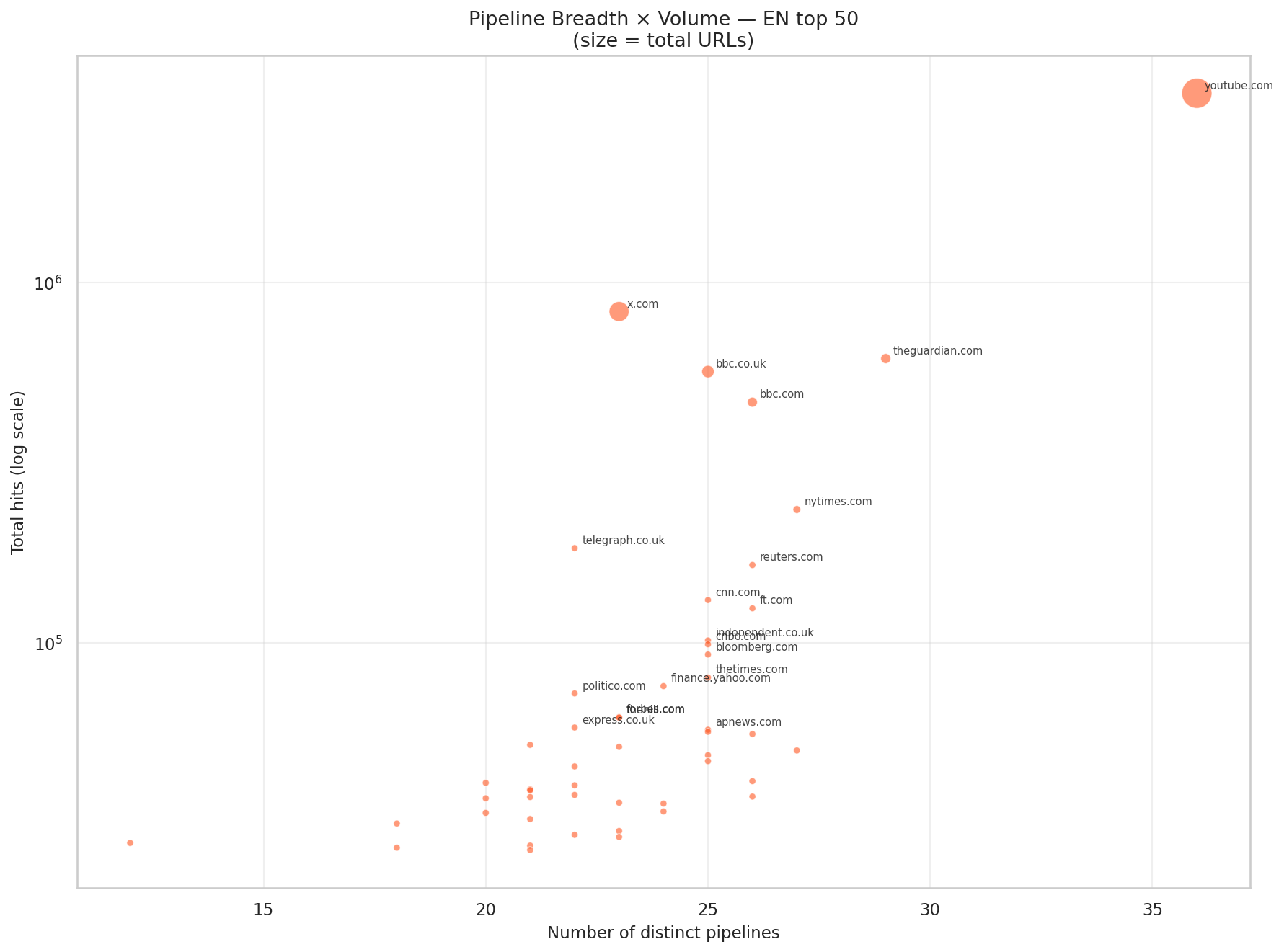
X = number of distinct pipelines per domain, Y = total volume (log). The correlation is clear: more pipeline breadth = more Discover volume. This chart validates the entire framework.
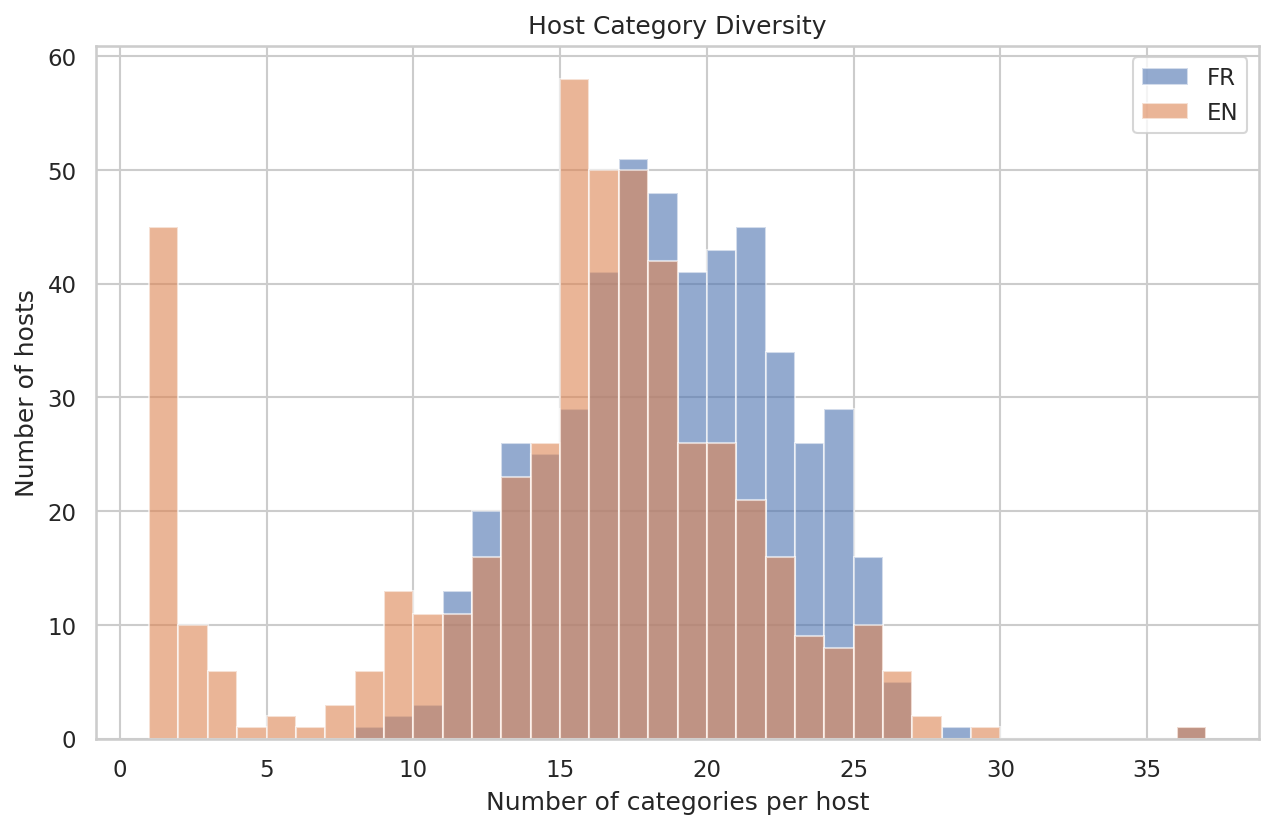
EN distribution is bimodal: spike at 1-2 (niche publishers) + peak at 15-17 (mainstream). The 7 profiles below map onto this distribution.
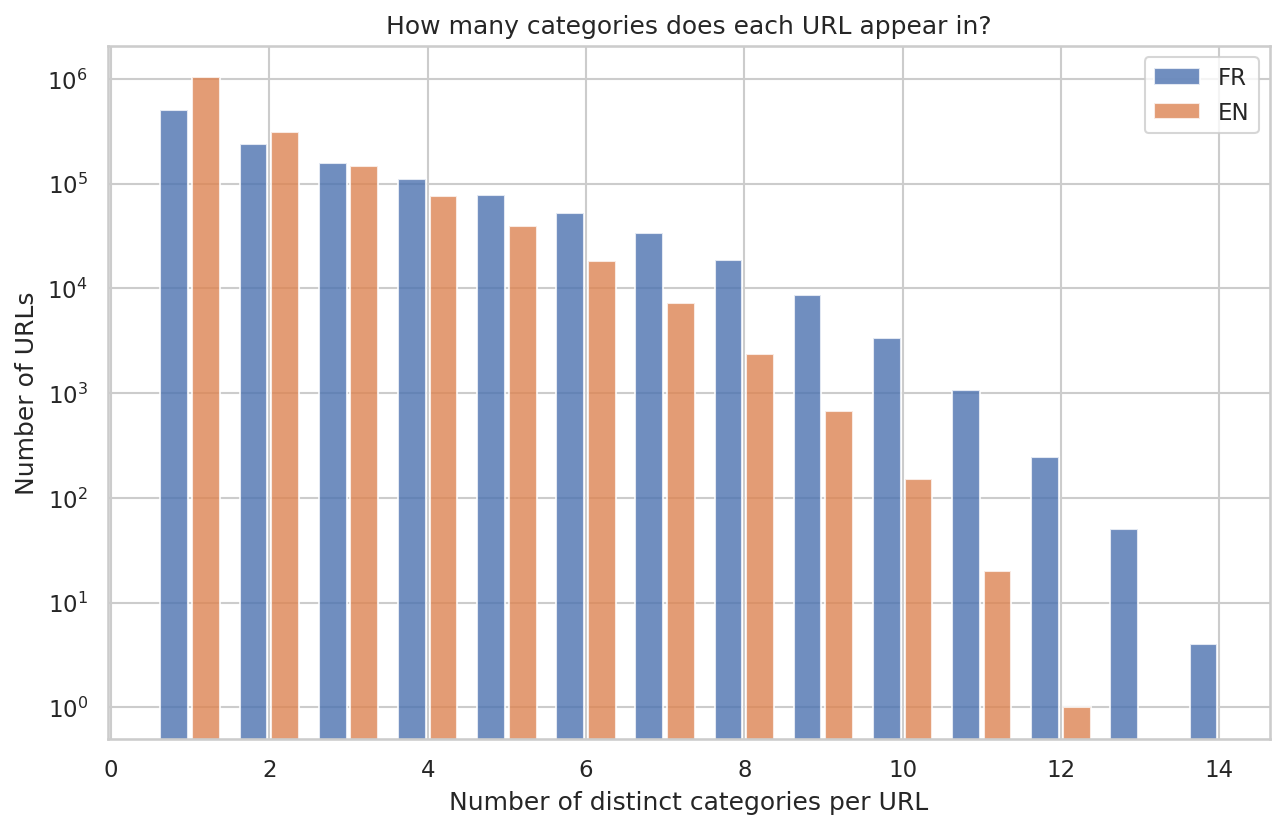
How many pipelines does each URL reach? The exponential drop-off is real, but the tail matters. Multi-pipeline articles get compounding visibility windows.
The 7 profiles
Profile A: National press (Guardian, NYT, BBC, Reuters)
Natural: content, moonstone, mustntmiss, nsh, deeptrendsfable, deeptrends, pagpan, ruby
Conquerable: aura (thematic diversification), geo (content with local anchoring), creatorcontent (social presence)
Ceiling: shopping (not product content), wklocal (not hyperlocal)
Score: 8-12 pipelines (highest multiplication potential)
Key lever: mustntmiss gives a ~2x priority boost. The Guardian reaches 26 pipelines, NYT 25, BBC 24. These titles dominate through editorial importance: politics, international affairs, economics. In EN, AIO readiness is an additional advantage: mustntmiss carries 29% AIO content, and the discover_ai_summary pipeline selects quality press (Reuters 7.8%, NYT 4.7%, CNBC 4.6%). Structured, factual reporting earns an extra pipeline.
Profile B: Regional press (local UK titles, US regional papers)
Natural: content, moonstone, webkicklocalstories, geotargetingstories, astria
Conquerable: mustntmiss (national-angle stories), deeptrendsfable (trending local topics), deeptrends (if the topic holds)
Ceiling: neoncluster (not video), shopping (not product)
Score: 6-10 pipelines
Key lever: webkicklocalstories is your dedicated channel, with 81% exclusive URLs in EN and near-instant pickup (0.1h median). Manchester Evening News reaches 9 pipelines, Liverpool Echo 7; the dual local/national angle opens moonstone and deeptrendsfable. The BBC local model shows how: a local story with a national dimension crosses into the broader system. Without this bridge, regional content stays in its 1-3 pipeline silo.
Profile C: Tech / review site (TechRadar, Tom’s Hardware, Tom’s Guide)
Natural: content, shoppinginspiration
Conquerable: aura (tech/science over-represented 2-2.4x), moonstone (engagement angle on launches), deeptrendsfable (if trending)
Ceiling: mustntmiss (not editorial importance), nsh (not breaking), wklocal (not local)
Score: 3-7 pipelines
Key lever: the EN shopping silo is softer than FR: 49% of shopping URLs also appear in content, 30% reach aura. TechRadar reaches 7 pipelines, Tom’s Hardware 6. The path to multiply: product content with an editorial/trend angle reaches aura + content. A product launch treated as a news event opens deeptrendsfable. The silo exists but is more permeable in EN.
Profile D: Lifestyle / entertainment (People, BuzzFeed)
Natural: content, moonstone
Conquerable: deeptrendsfable (trending celebrity/cultural events)
Ceiling: mustntmiss, aura, deeptrends, all local pipelines, shopping
Score: 2-3 pipelines (structural ceiling)
Key lever: moonstone loves engagement content. People.com reaches 14 pipelines but volume is concentrated in content + moonstone. This is a single-pipeline strategy: maximize moonstone reach rather than fighting for the others. Trending cultural events can temporarily unlock deeptrendsfable, but it’s occasional.
Profile E: Business / finance (FT, CNBC, Bloomberg, Reuters)
Natural: content, aura (finance/business 1.5-1.6x over-represented), mustntmiss (when economically significant)
Conquerable: deeptrendsfable (economic trends), discover_ai_summary (quality press selected for AIO)
Ceiling: moonstone (lower engagement), shopping (not product), social pipelines
Score: 4-6 pipelines
Key lever: aura is your natural habitat: finance.yahoo.com, Reuters, FT are top aura sources. AIO readiness is a measurable advantage: CNBC (19 pipelines), Bloomberg (18), FT (20) all reach discover_ai_summary. Structured financial content earns the AIO pipeline on top of the editorial pipeline stack. This is the profile where EN has the clearest advantage over FR markets.
Profile F: Video / YouTube (YouTube channels, video creators)
Natural: creatorcontent, freshvideos, neoncluster
Conquerable: deeptrendsfable (trending video topics)
Ceiling: mustntmiss, shopping, local pipelines, most text-oriented pipelines
Score: 3-4 pipelines (EN), 1-2 (FR)
Key lever: the cascade IS the strategy. YouTube dominates creatorcontent (72%), freshvideos (94%), neoncluster (100%). Neoncluster at 13% reach is broadcast-level, higher than content (8.8%). The cascade grew 18x in 3 months. Create content that enters creatorcontent → let the three-stage filter amplify. In FR, this strategy doesn’t work: the cascade barely exists. FR creators rely on x.com via creatorcontent instead.
Profile G: Sports (ESPN, Sky Sports)
Natural: content, moonstone, paginationpanoptic
Conquerable: creatorcontent (via YouTube/x.com), freshvideos (highlights)
Ceiling: aura, astria, wklocal, deeptrends. Plus: EPL structural exclusion across 7+ pipelines.
Score: 2-4 pipelines
Key lever: event coverage (Olympics, Super Bowl, World Cup) temporarily breaks the sports ceiling, opening deeptrendsfable, mustntmiss, nsh. But daily sports coverage is structurally limited to content + moonstone. ESPN reaches 14 pipelines but the bulk is in those two. The EPL exclusion adds a layer unique to EN: even event-level football is suppressed. For American sports (NFL, NBA) the ceiling is softer.
The matrix
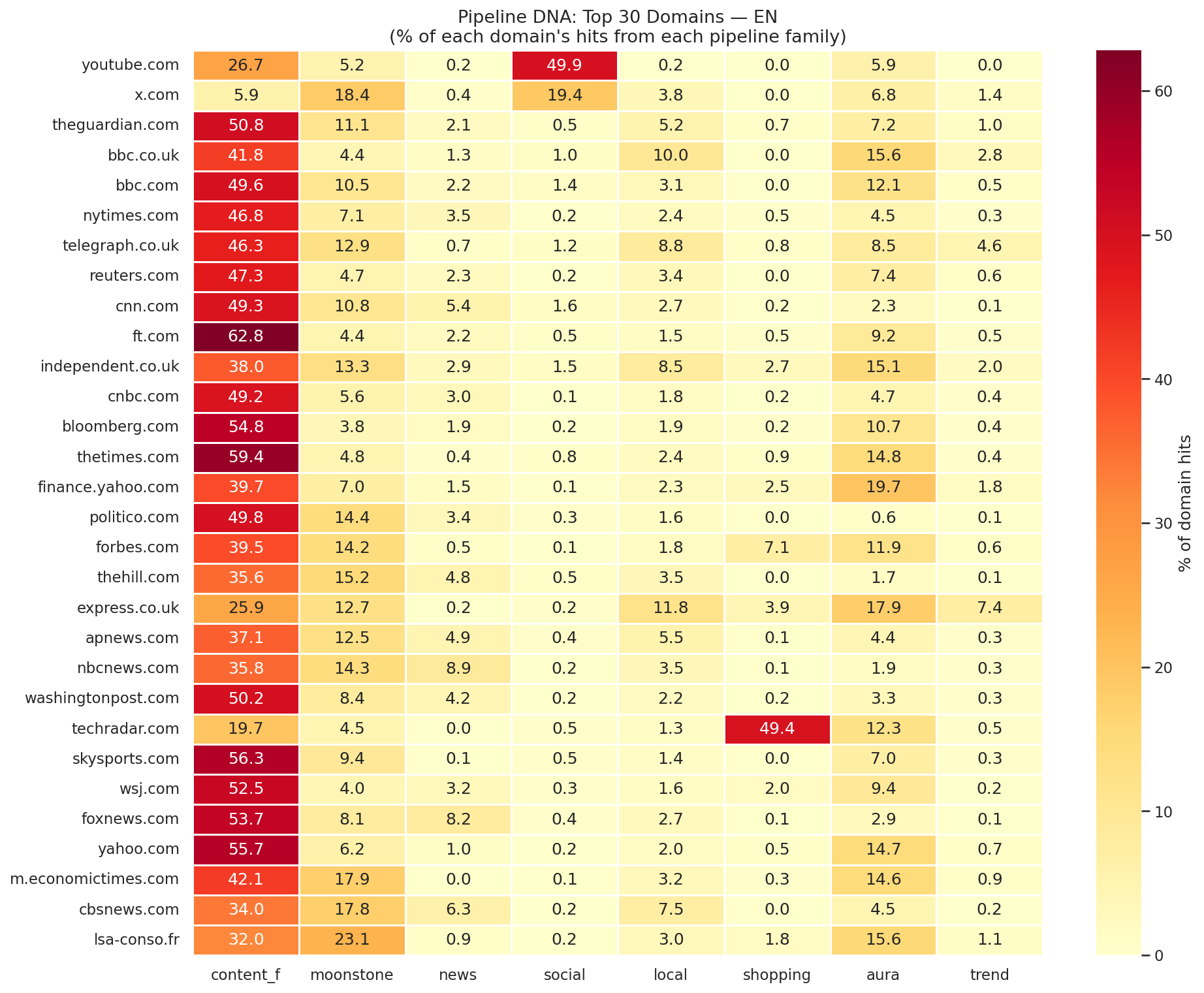
The real data behind the abstract profiles. Find the Guardian (Profile A: content + mustntmiss strong), BBC local (Profile B: wklocal + geo spread), TechRadar (Profile C: shopping concentrated). The heatmap makes the profiles concrete.
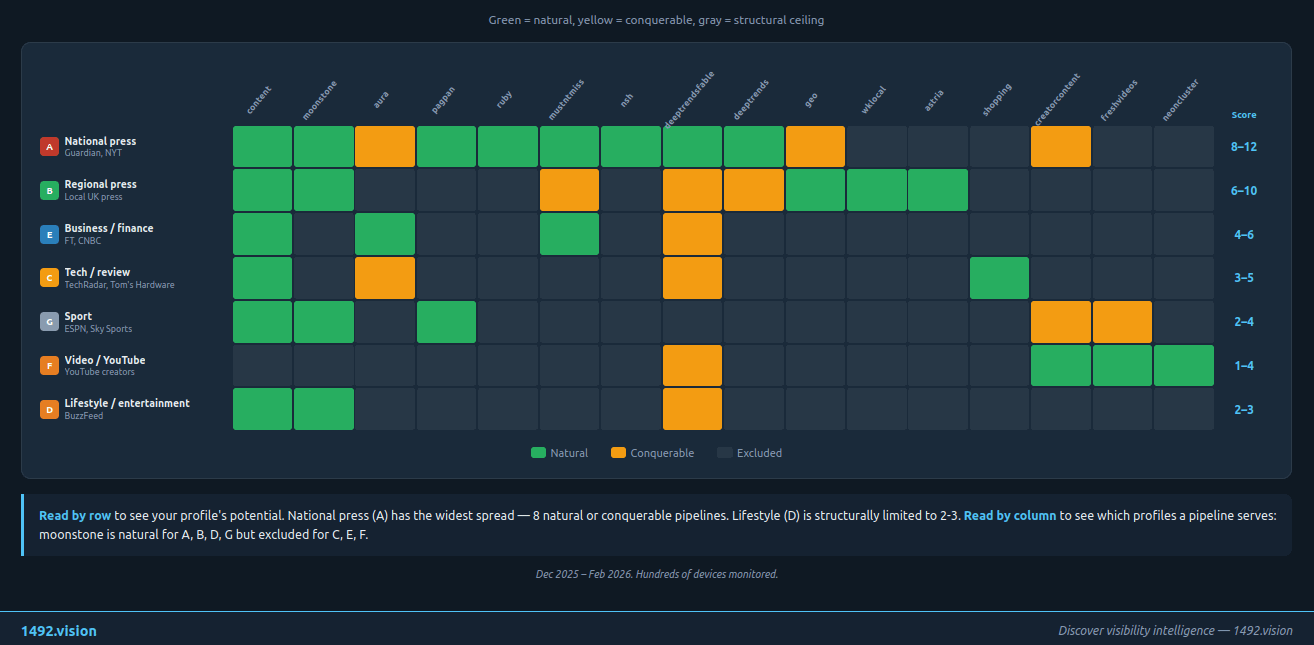
The full matrix: rows = publisher profiles, columns = pipelines. Green = natural access, orange = reachable with editorial adjustment.
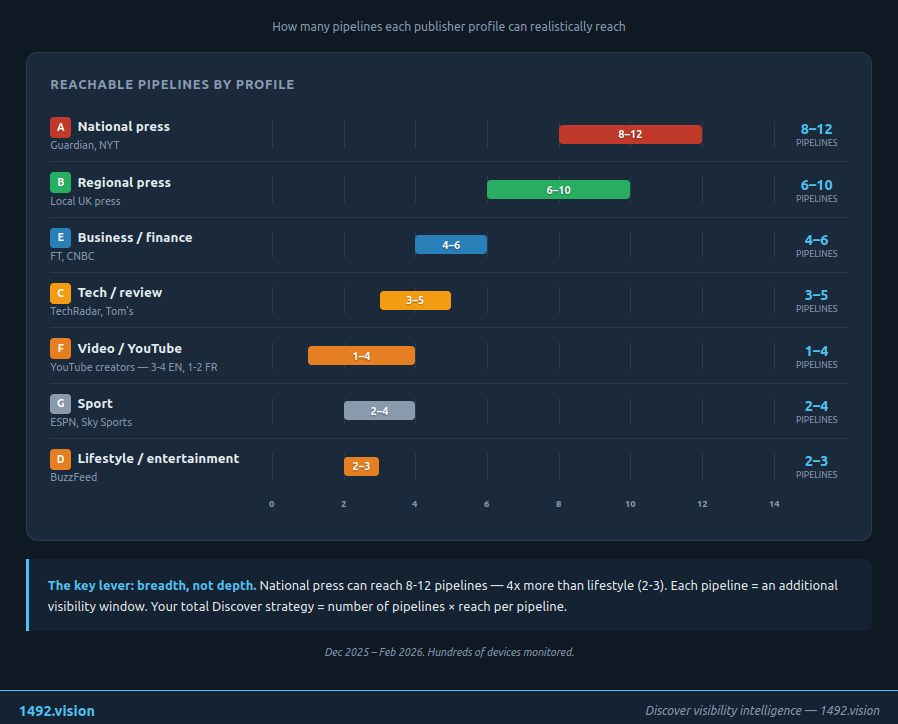
The scorecard: how many pipelines can each profile realistically reach?
The essential insight
Your total Discover visibility = how many pipelines you reach, not how well you optimize for one.
A national press article in 8 pipelines has more total visibility windows than a product review with 13.1% reach in a single pipeline.
The pipeline multiplication strategy: identify your conquerable pipelines and create content that crosses into them, without abandoning your natural strengths.
The EN ecosystem offers two unique levers that FR doesn’t: the YouTube cascade (3-4 pipelines for video creators) and AIO readiness (an extra pipeline for quality press). Both are growing fast. Factor them in.
This data doesn’t surface in our public tool yet, but we can generate detailed pipeline-level analyses comparing you against your competitors.
If you’re a client, open a support ticket and we’ll see what we can do for you!
This analysis is based on 3 months of data collected across hundreds of devices. For per-pipeline analytics on your own domain: 1492.vision.
Full data: 1492.vision | Interactive: explorer | Full series: Substack
Data: 42 million Discover cards, Dec 2025 – Feb 2026. Analysis: 1492.vision.
 | A guest post by
|