Google Discover is not a single algorithm
It’s more than 20 pipelines


When your article appears in Google Discover, which algorithm selected it? Most publishers assume: one. The answer: one of 20+ internal pipelines, each with a different role.
The map nobody had
We analyzed 42 million Discover cards collected from hundreds of devices over months (December 2025 – February 2026). For each card, we traced the pipeline responsible for its selection. The result: 20+ pipelines organized into six functional layers — plus a seventh, AI-only layer unique to English.
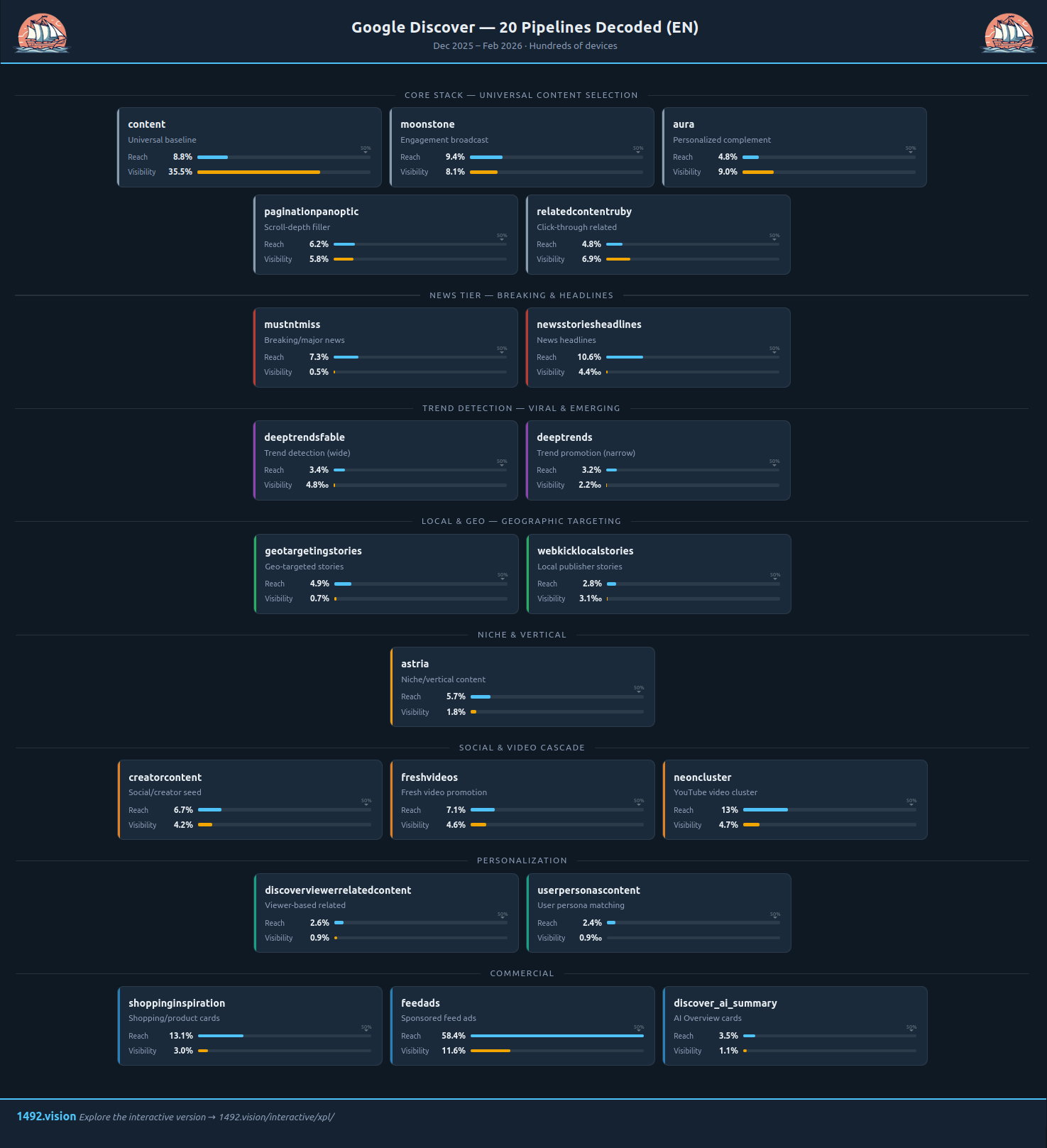
The 20 EN pipelines organized into 6 functional layers. Same structure as French, radically different proportions. This is a screenshot of our freely available Interactive Discover Pipeline Explorer
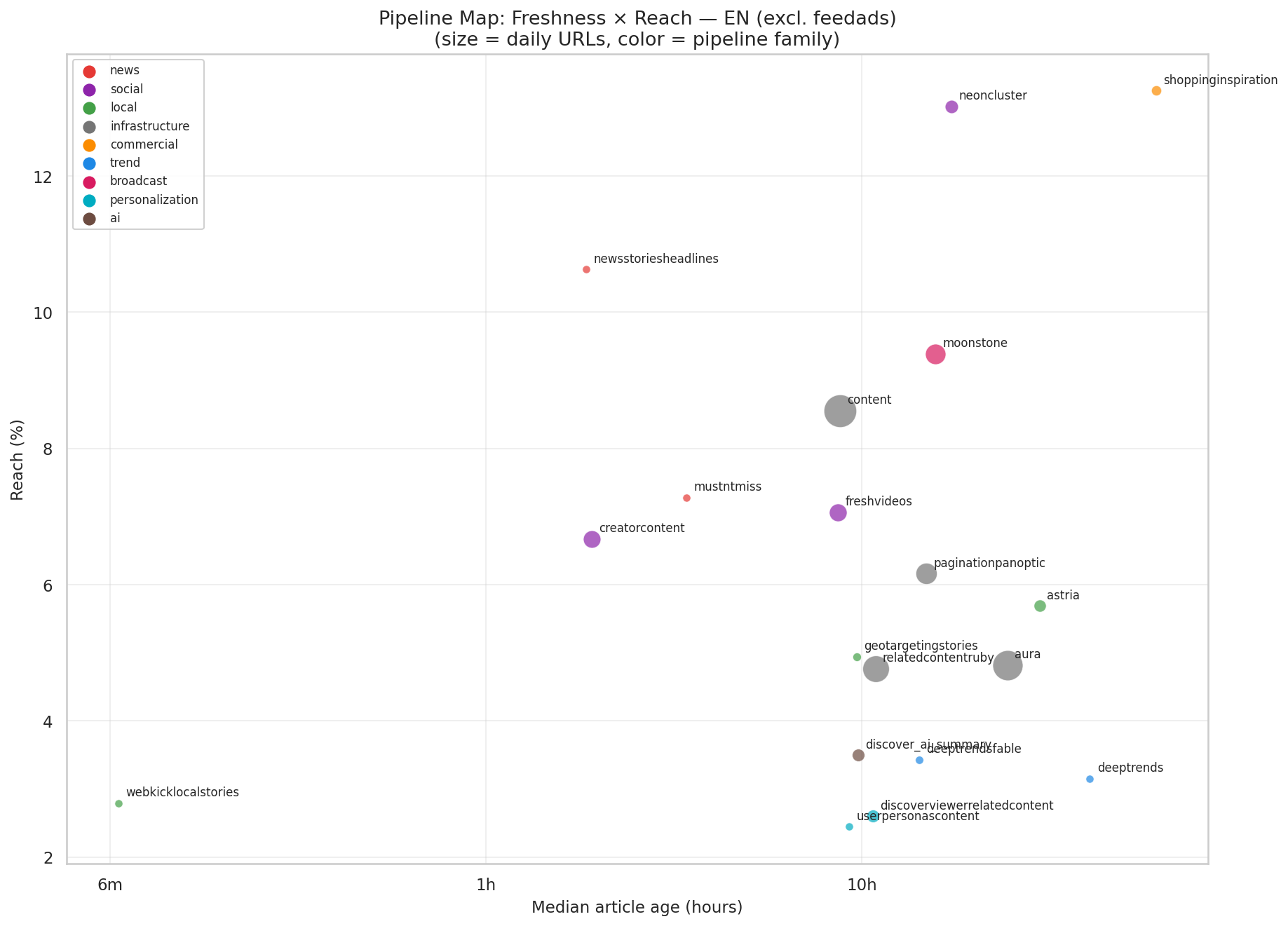
Each pipeline positioned by speed (X, log) and reach (Y). neoncluster stands out at 13% reach — the highest editorial pipeline. feedads is the extreme outlier at 58.4% (excluded from the graph) . Breaking pipelines (nsh, mustntmiss) cluster top-left; personalization pipelines bottom-right.
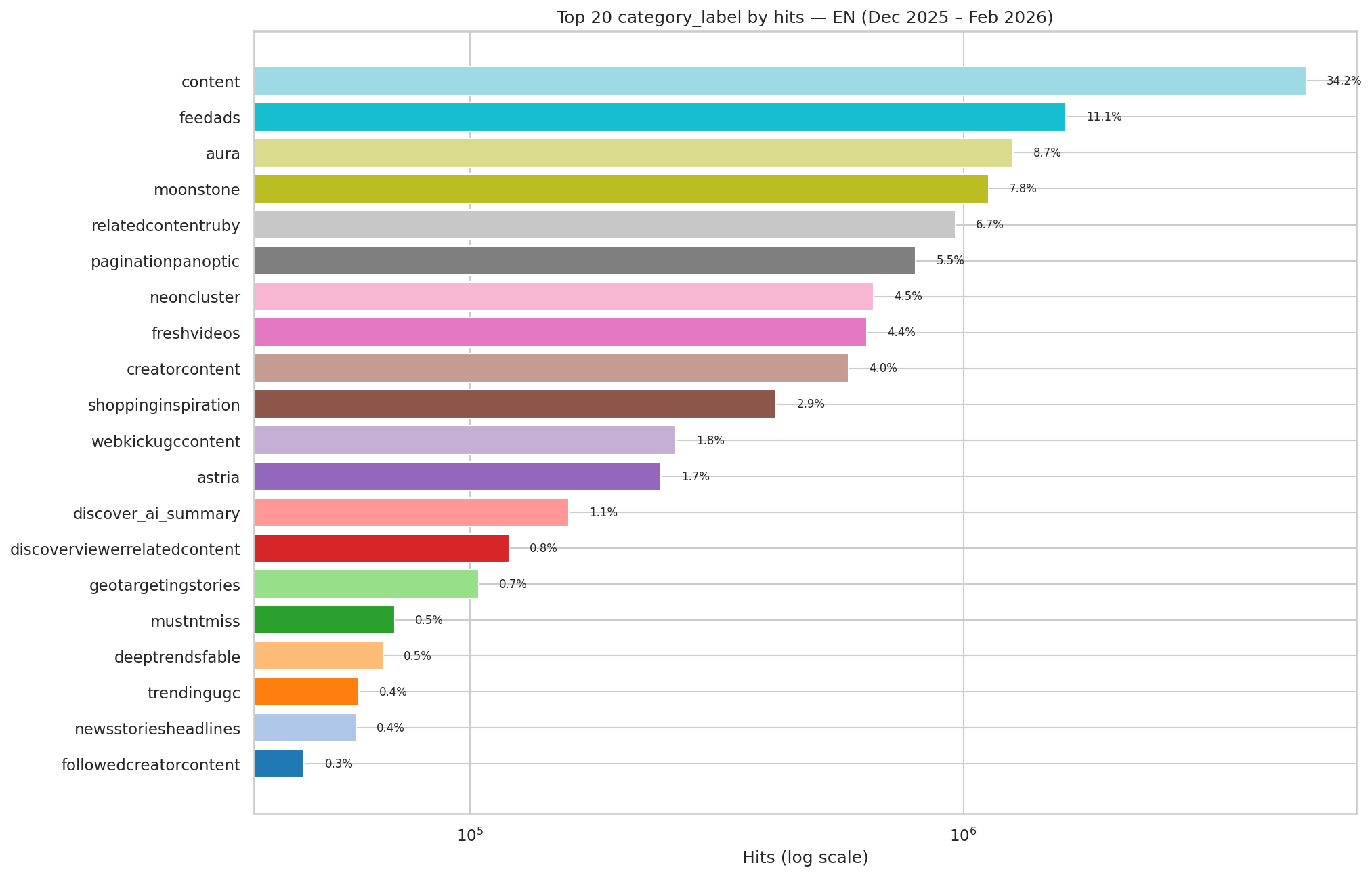
The 20 EN pipelines ranked by volume. content at 34.2%, feedads 11.1%, aura 8.7%.
Layer 1 — The editorial core
Five pipelines form the main recycling loop: content (baseline, 34.2% of volume — significantly higher than French’s 30.7%), moonstone (engagement broadcast, 9.4% reach — half the French level), aura (long-tail diversifier, science/tech over-represented 2-2.4x), paginationpanoptic (scroll infrastructure, 5.5%) and relatedcontentruby (click-triggered related content, 6.7%).
Layer 2 — News urgency
mustntmiss (editorial importance, ~2x priority boost, 29% AI Overview content — the highest AIO penetration of any non-dedicated pipeline) and newsstoriesheadlines (breaking, Google News story clusters, 10.6% reach). Only 5% overlap between the two — two independent logics.
Layer 3 — Trends
deeptrendsfable → deeptrends: a sequential 2-stage pipeline. 27% pass rate, +21h delay. BBC dominates deeptrends at 24.7%. x.com is a trend signal source even in EN.
Layer 4 — Local/geo
Three distinct approaches: geotargetingstories (x.com dominates at 43.2% in EN — very different from FR), webkicklocalstories (hyperlocal, 67% exclusive URLs, UK/US local press), astria (local authority, BBC 29.3%, 1.5-day delay).
Layer 5 — Social and video
The most distinctive layer in English. The YouTube cascade — three pipelines forming a sequential amplifier:
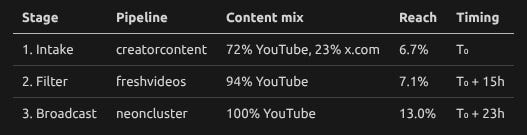
At each stage, content narrows (mixed → pure video) and reach increases (6.7% → 13%). Growth: creatorcontent 7.8x, freshvideos 7.2x, neoncluster 18x over three months.
This cascade doesn’t exist in French — neoncluster has 36 hits in 3 months in FR. The conditions (YouTube-dominant social, pure video content, broadcast audience) are only met in English.
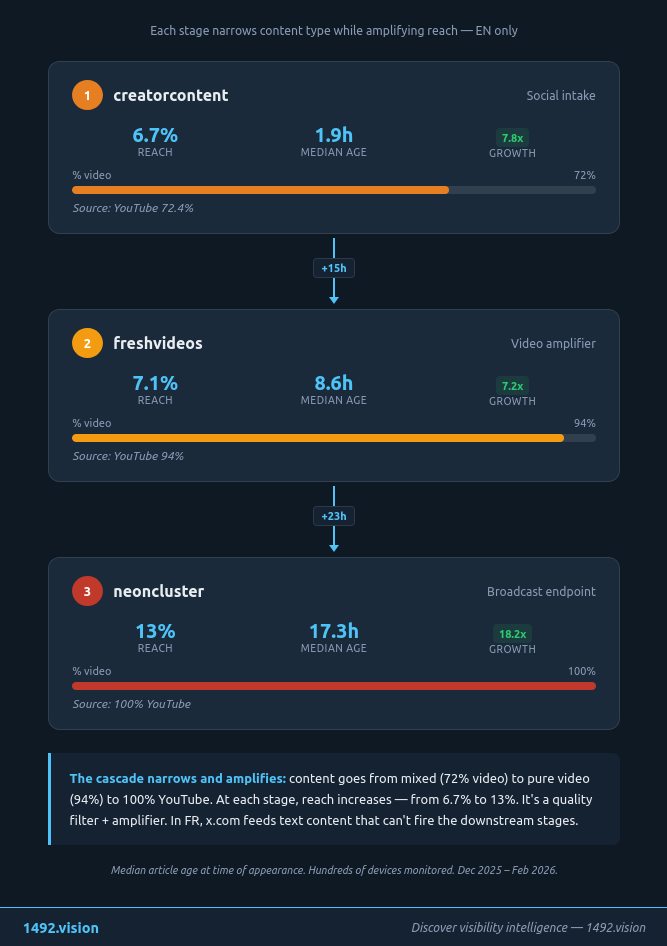
The three-stage video cascade: creatorcontent (intake, 1.9h) → freshvideos (amplifier, 8.6h) → neoncluster (broadcast, 17.3h, 13% reach). At each stage, content narrows toward pure video and reach increases.
Layer 6 — Commercial
shoppinginspiration (13.1% reach, 2.5-day lifespan — still much longer than a news article) and feedads (pure advertising, 58.4% reach — the single most powerful pipeline by reach in any language. YouTube accounts for 53.7% of ads. For context: the highest-reach editorial pipeline reaches 13%. feedads reaches 4.5x more).
Layer 7 — AI Overview (EN-only)
discover_ai_summary: 1.1% of volume, 99.997% AIO content. A new layer that doesn’t exist in French Discover. The source club is small and elite: Reuters (12.3%), NYT (7.5%), CNBC (7.3%), Financial Times, Guardian. Factual, structured, financial press. AIO in Discover doesn’t democratize visibility — it concentrates it.
The hidden dimension: position in the feed
Pipelines don’t just control selection — they also control where content appears in the feed.
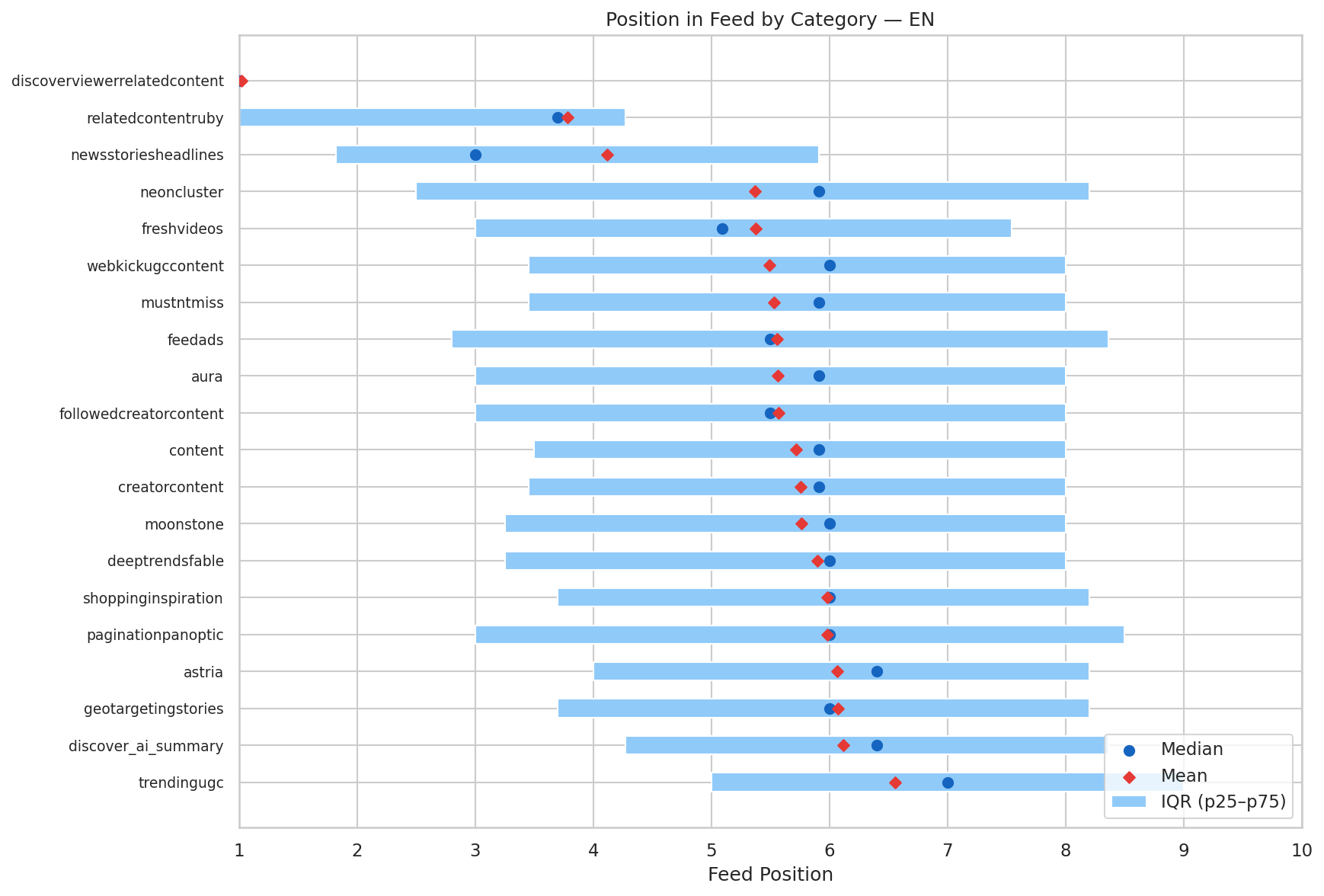
Median position by pipeline. Breaking news and related content in positions 2-4 (top of feed). Engagement and shopping in positions 6-8 (deeper).
This is an architecture choice: breaking news captures attention at the top, engagement content rewards scrolling, products persist deeper in the feed.
Why this changes everything
An article in 1 pipeline vs 5 pipelines = fundamentally different visibility. Each pipeline has its own timing, audience, and position in the feed.
Optimizing “for Discover” without knowing which pipeline you’re targeting is like optimizing “for Google” without understanding the difference between Search, News, and Shopping.
A living system
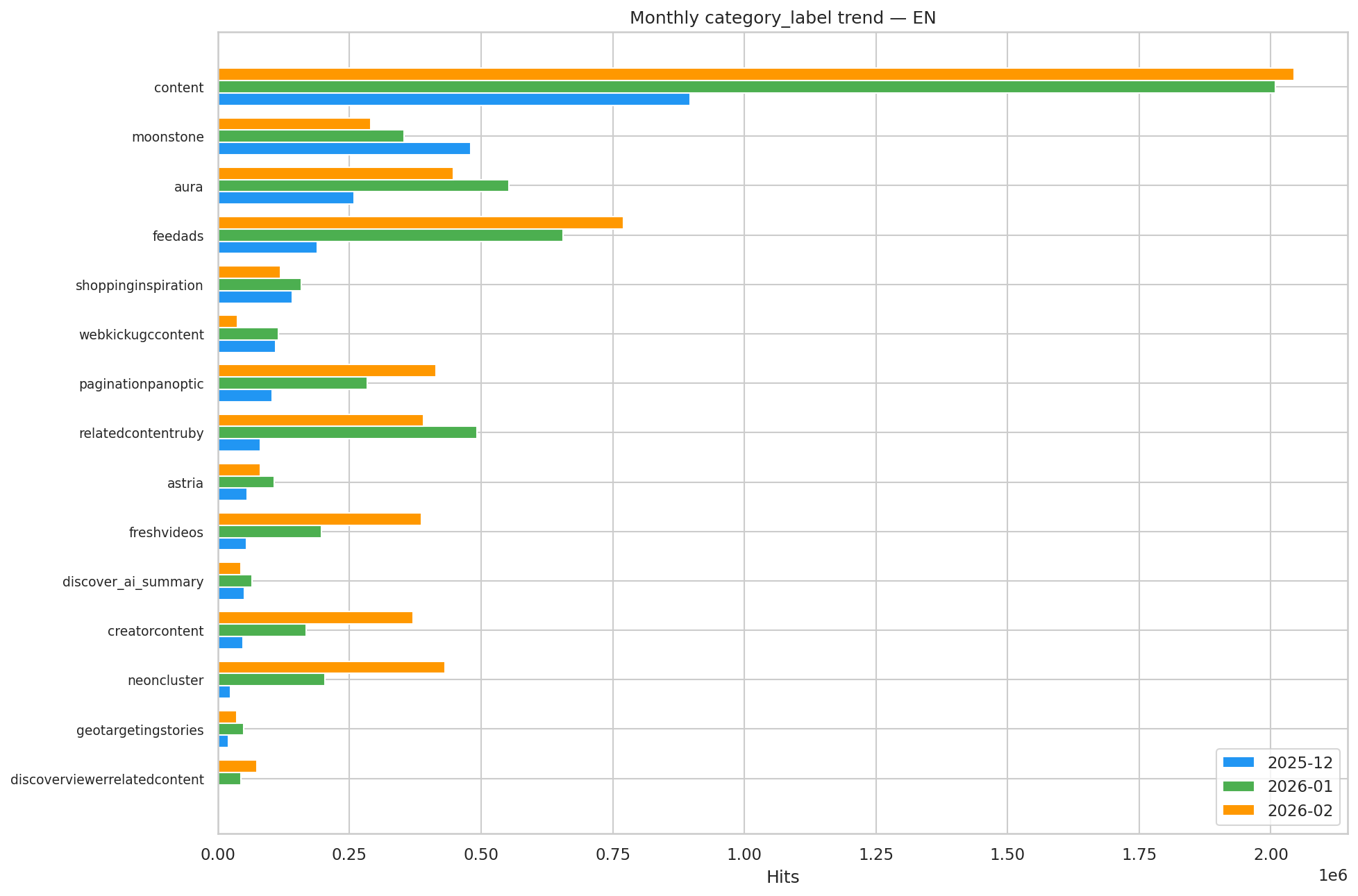
Grouped bars Dec/Jan/Feb. The video cascade is exploding: neoncluster 18x in three months. The system evolves month by month.
The landscape is shifting: ~10 abandoned pipelines (the entire queryrecommendations* family — the old query-based system), ~8 new ones identified (collaborative filtering, NL tuning, entertainment trailers). The direction: from query-based to embeddings/personas, from text to social/video, from passive selection to real-time engagement.
Understanding the layers is more durable than memorizing pipeline names. The names change — the structure persists.
Next newsletter: moonstone deep-dive — the pipeline that shows your articles to 1 in 10 readers in EN (1 in 5 in FR). How it selects, who dominates, and what it avoids.
Explore all 20 pipelines: the interactive explorer | Full reference research articles: 1492.vision/research
Subscribe to our Substack to make sure you don’t miss upcoming deep-dives. For 1492.Vision customers, this new data will surface in the tool and API soon, giving you new levers to work with.
Data: 42 million Discover cards, Dec 2025 – Feb 2026. Analysis: 1492.vision.
 | A guest post by
|